
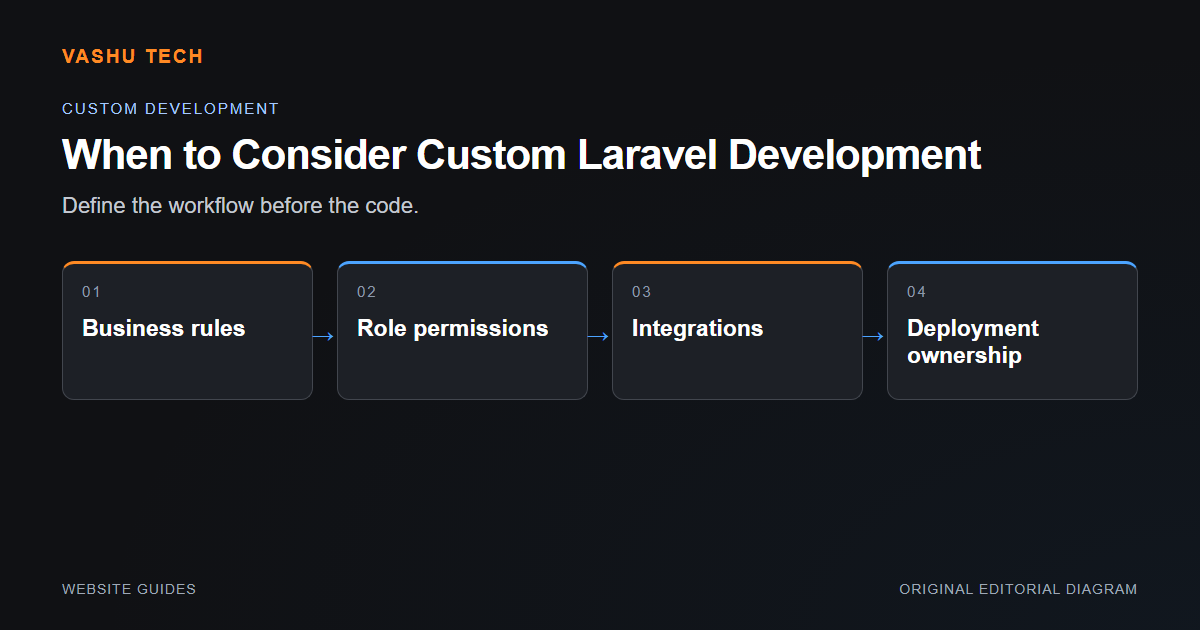
Custom Laravel development is worth considering when the project has specific records, roles and workflow rules that ordinary platform configuration cannot express well. The decision should follow the requirement, not a preference for a framework. A custom application also needs long-term code, deployment and access ownership.
Identify the workflow that needs control
Describe who creates records, who reviews them and which transitions are allowed. Include exceptions, corrections and concurrent edits. A set of screens is not a full specification if the permission rules remain unclear. Consider whether an existing tool can meet the requirement before commissioning a new application.
Plan operational responsibilities
Database migrations, background jobs, scheduled actions and environment configuration affect deployment. Define backups and release recovery alongside features. Tests should verify denied actions as well as successful ones. A framework provides useful mechanisms, but it does not automatically decide the right business rules.
Example: a request needs staged approval
A custom workflow can represent states and record why a transition occurred. Hiding an approval button is not enough: the server must authorize the action. Define who may see the request and how an incorrect decision can be corrected.
Project checklist
- Map records and state transitions
- Define role boundaries
- Review existing tool alternatives
- Plan queues and deployment
- Test denied and concurrent actions