
Requirements first
Caching the wrong pages can break forms or show stale account information, while excessive plugin assets can delay pages that do not use those features.
WordPress speed work evaluates themes, plugins, images, database activity and hosting together. It is useful when pages are slow despite a caching tool, or when a builder-heavy site sends excessive assets to visitors. The scope should begin with measurements from important page types and logged-in or transactional journeys where relevant. Improvements must preserve content editing and dynamic functionality.
A clear scope, practical review points and communication around your actual requirements.
Caching the wrong pages can break forms or show stale account information, while excessive plugin assets can delay pages that do not use those features.
For WordPress Speed Optimization, agree content ownership, access, approvals and the person who handles questions throughout the project.
Not all WordPress pages can be cached identically. Account areas, cart pages and nonces need appropriate handling. Hosting changes and premium optimization tools are separate costs that should be justified by evidence.
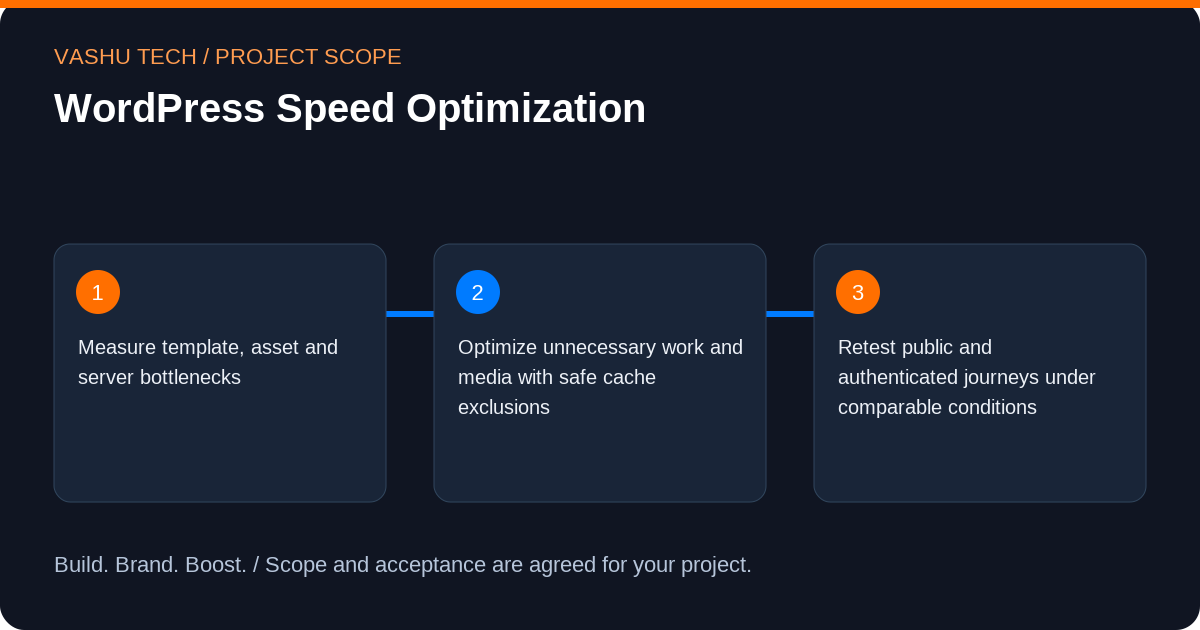
Use the WordPress Speed Optimization tasks as acceptance criteria: Measure template, asset and server bottlenecks; Optimize unnecessary work and media with safe cache exclusions; Retest public and authenticated journeys under comparable conditions.
Choose the work relevant to your starting point. Final deliverables are agreed in your proposal.
For WordPress Speed Optimization, this stage covers measure template, asset and server bottlenecks. Agree the necessary inputs, intended output and review criteria before work starts.
For WordPress Speed Optimization, this stage covers optimize unnecessary work and media with safe cache exclusions. Agree the necessary inputs, intended output and review criteria before work starts.
For WordPress Speed Optimization, this stage covers retest public and authenticated journeys under comparable conditions. Agree the necessary inputs, intended output and review criteria before work starts.
Caching the wrong pages can break forms or show stale account information, while excessive plugin assets can delay pages that do not use those features.
Not all WordPress pages can be cached identically. Account areas, cart pages and nonces need appropriate handling. Hosting changes and premium optimization tools are separate costs that should be justified by evidence.
Check the agreed WordPress Speed Optimization scope against representative examples. Confirm what is delivered, who maintains it and which follow-up tasks are separate.
Five practical stages from initial brief to reviewed handover.
Share the current situation, priority audience and the issue this WordPress Speed Optimization work should address.
Confirm measure template, asset and server bottlenecks, required inputs, dependencies and the agreed review points.
Carry out the approved scope, including optimize unnecessary work and media with safe cache exclusions, with changes reviewed against the brief.
Review the selected theme, plugins, editing workflow and relevant interactions using representative content.
Confirm acceptance of the WordPress Speed Optimization deliverables, ownership, documentation and any separately agreed ongoing support.
Confirm the included outputs before implementation; optional work is identified separately.
A written WordPress Speed Optimization brief covering the audience, current situation and priority: caching the wrong pages can break forms or show stale account information, while excessive plugin assets can delay pages that do not use those features.
Measure template, asset and server bottlenecks; Optimize unnecessary work and media with safe cache exclusions; Retest public and authenticated journeys under comparable conditions.
Review the selected theme, plugins, editing workflow and relevant interactions using representative content.
Not all WordPress pages can be cached identically. Account areas, cart pages and nonces need appropriate handling. Hosting changes and premium optimization tools are separate costs that should be justified by evidence.
Check the agreed WordPress Speed Optimization tasks using real or approved representative examples, including relevant failure cases.
Confirm who maintains the result, how access is handed over and which improvements or support are outside the initial WordPress Speed Optimization agreement.
Choose the checks relevant to your WordPress Speed Optimization project; no ranking or business result is promised.
Where WordPress Speed Optimization affects public pages, organize accurate headings, service descriptions and useful links around the intended audience.
Review the selected theme, plugins, editing workflow and relevant interactions using representative content. Where applicable, include keyboard access, readable text and mobile interaction checks.
Agree how WordPress Speed Optimization work is evaluated. Separate implementation evidence from traffic, enquiries or sales, and configure analytics only where approved.
Discuss how WordPress Speed Optimization fits your audience, workflow and operational requirements.
WordPress speed work evaluates themes, plugins, images, database activity and hosting together. It is useful when pages are slow despite a caching tool, or when a builder-heavy site sends excessive assets to visitors. The scope should begin with measurements from important page types and logged-in or transactional journeys where relevant. Improvements must preserve content editing and dynamic functionality.
WordPress can provide editable pages and articles alongside extensions for more specialized requirements. The theme, plugins, hosting and update process all influence the finished website. A project may involve a new installation, a visual redesign, a builder layout or investigation of an existing problem. These are different scopes. Review licences, editor responsibilities and compatibility before selecting tools. Existing content and user records should be protected during changes, and backups should have a tested recovery path rather than being treated as an installation checkbox.
Caching the wrong pages can break forms or show stale account information, while excessive plugin assets can delay pages that do not use those features.
These stages describe the discussion scope for this service. The proposal should identify which outputs are included, the information required from you and any work that belongs to a separate agreement. Review points should make it possible to check the result against the original requirement.
Not all WordPress pages can be cached identically. Account areas, cart pages and nonces need appropriate handling. Hosting changes and premium optimization tools are separate costs that should be justified by evidence.
The practical value is addressing this specific difficulty: caching the wrong pages can break forms or show stale account information, while excessive plugin assets can delay pages that do not use those features. A useful result makes the relevant journey or operational responsibility clearer. Define the acceptance checks around retest public and authenticated journeys under comparable conditions, and distinguish an implemented improvement from an unverified business outcome.
An estimate depends on the existing environment, the amount of content or data involved and the agreed testing and access requirements. External licences, hosting and vendor subscriptions should be identified separately. Share any deadline and its dependencies so that feasibility can be assessed; this page does not promise a fixed price or delivery date.
Describe the current situation and the change you need. A public website link and a short explanation are enough to begin; arrange sensitive access separately. Request a scoped quote or contact Vashu Tech to discuss the next step.
Start with how your team will edit the website. Choose the necessary page types, content fields and integrations before selecting a theme or plugins. For an existing installation, the current editor, licences and compatibility constraints are part of the brief; a visual change should not unnecessarily disrupt a working publishing process.
For WordPress Speed Optimization, start by identifying the decision or workflow you want to improve. Caching the wrong pages can break forms or show stale account information, while excessive plugin assets can delay pages that do not use those features. Select the tasks that address that requirement; the full category of work does not have to be included in every project.
Useful starting information includes the public website, current theme or builder, relevant plugin names, editing needs and an explanation of the affected page or feature. Public links and redacted examples are enough for an initial discussion. Account access can be arranged separately after the required permissions are understood.
Consider a business that updates services regularly but struggles to keep page layouts consistent. An agreed set of editable sections could make those updates easier while retaining approved brand choices. A plugin conflict or one broken form may instead call for a focused investigation.
Translate that example into a small, testable brief for WordPress Speed Optimization: begin with measure template, asset and server bottlenecks, identify the inputs needed to optimize unnecessary work and media with safe cache exclusions, and agree how to retest public and authenticated journeys under comparable conditions. This is an illustrative planning scenario, not a client case study or a promised result.
Check both the public page and the editor workflow. Review forms, media, navigation and any agreed store features with representative content. Confirm that changes remain compatible with the relevant theme and plugins; update testing and licence responsibilities should be recorded separately.
Keep a short acceptance checklist alongside the proposal. For this scope, the review should include: Measure template, asset and server bottlenecks; Optimize unnecessary work and media with safe cache exclusions; Retest public and authenticated journeys under comparable conditions. Record what was checked, which items remain open and who can approve the result. An implemented change and a business outcome are different things; neither enquiries nor sales should be assumed from a technical demonstration.
The handover can explain the editing workflow, theme and plugin responsibilities, licence ownership and the included maintenance arrangements. Agree who will approve updates and how future issues should be reported.
Before handover, agree who owns the accounts, approves public information and handles future changes. Any maintenance, additional content, third-party subscription or ongoing campaign management should be listed explicitly in the proposal. Share an essential deadline early so dependencies can be discussed before a delivery schedule is agreed.
WordPress Speed Optimization should be scoped around the part of the business journey that needs attention. Caching the wrong pages can break forms or show stale account information, while excessive plugin assets can delay pages that do not use those features. Describe the starting point before deciding whether the work requires a focused change, a new implementation or a wider review. Existing content, records and useful behaviour should be identified before any change is approved.
A WordPress project involves the content model, theme, extensions and hosting arrangement together. Review the current installation before choosing additional components or replacing working ones. Establish which edits should be possible through the dashboard and which are intentionally technical. Document existing customisations and licences. Changes should be checked against realistic content and the affected workflows, rather than assuming that a compatible version number proves the complete setup works.
Share public page URLs, the problem description and the editing tasks staff need to perform. Identify the theme, relevant plugins, licences and known custom work if this information is available. Describe recent changes when requesting corrective work. Arrange authorised technical access separately. Confirm that the environment used for review protects private information and does not send test notifications or transactions to real visitors.
Identify the person who can approve public information and the person responsible for the operational result. Share public URLs and redacted examples first. Arrange sensitive access separately with suitable permissions. If there are deadlines, explain the event behind them and any approvals still needed. Ready content and verified account access can change the practical scope; they should be discussed before confirming the implementation plan.
A hypothetical business needs staff to update service details without changing page structure. The project can define controlled editing fields and review them against the existing theme. A representative service is used to test long text, media replacement and contact actions before the approach is applied to the remaining relevant pages.
For this service, adapt the example to Measure template, asset and server bottlenecks; Optimize unnecessary work and media with safe cache exclusions; Retest public and authenticated journeys under comparable conditions. Identify the starting behaviour, expected change and the check that demonstrates the result. These are hypothetical planning situations, not claims about Vashu Tech clients or results. A useful example narrows the discussion to real requirements without assuming that every business needs the same features or the same amount of work.
Check the agreed editing experience, public output, navigation and affected forms. Include relevant extension interactions and existing customisations. Test both a fresh visitor session and applicable signed-in behaviour. Review update responsibilities and the recovery approach. If work addresses an error, retain reproducible verification steps so recovery is demonstrated beyond a single successful page load.
Use a written checklist with a requirement, expected result and evidence for each important task. Include representative data and exceptions as well as the successful demonstration. Where work affects a visitor action, review the staff or administrative outcome too. Separate local verification, an authorised live release and ongoing operation. Record external-provider checks honestly instead of presenting entered configuration as proof that a real service has completed its work.
Clarify licences, extension subscriptions, hosting support and maintenance separately from the implementation. A theme change does not automatically include a complete content rewrite, malware investigation or every integration. Updates and backups need agreed ownership. No extension can justify a guarantee that the site cannot fail or be compromised. Define the actual work and its acceptance evidence instead of relying on a broad package name.
The proposal should distinguish the initial outputs from content writing, new integrations, additional pages and ongoing support that are not included. Confirm ownership of accounts and files, documentation, ordinary editing tasks and the process for future changes. Agree how new requirements affect the estimate and schedule. Handover should make the result understandable to the responsible team, with unresolved dependencies recorded and a clear next step for each.
Audience, scope and coordination for WordPress Speed Optimization.
Businesses evaluating WordPress Speed Optimization for a new requirement or an existing website. Caching the wrong pages can break forms or show stale account information, while excessive plugin assets can delay pages that do not use those features.
Measure template, asset and server bottlenecks Optimize unnecessary work and media with safe cache exclusions Retest public and authenticated journeys under comparable conditions Scope, exclusions and acceptance evidence are agreed in the proposal.
Answers to help you plan the scope and next steps.
No. Caching helps particular workloads, but theme assets, image delivery, database queries and hosting constraints may need separate attention.
Include the affected website or proposed project, the audience and the outcome you need. For this work, useful discussion points include measure template, asset and server bottlenecks, optimize unnecessary work and media with safe cache exclusions, retest public and authenticated journeys under comparable conditions. Do not send passwords in the public form.
The amount of existing work to inspect, the agreed deliverables, access readiness and testing requirements affect the estimate. Not all WordPress pages can be cached identically. Account areas, cart pages and nonces need appropriate handling. Hosting changes and premium optimization tools are separate costs that should be justified by evidence. Ask for a scoped proposal rather than assuming a fixed package or completion date.
Acceptance should reflect the actual requirement: measure template, asset and server bottlenecks; optimize unnecessary work and media with safe cache exclusions; retest public and authenticated journeys under comparable conditions. Check representative content and failure cases as well as the expected successful result. Agree the evidence and handover responsibilities before work begins.
Bring the public website, current theme or builder, relevant plugin names, editing needs and an explanation of the affected page or feature. Identify your priority and which tasks you need: Measure template, asset and server bottlenecks; Optimize unnecessary work and media with safe cache exclusions; Retest public and authenticated journeys under comparable conditions. Share public or redacted information first; arrange sensitive access separately.
The handover can explain the editing workflow, theme and plugin responsibilities, licence ownership and the included maintenance arrangements. Agree who will approve updates and how future issues should be reported. Confirm account ownership, approval responsibilities and any ongoing support separately from the initial work.
Share your starting point and priorities. We can discuss the scope, required information and acceptance checks before providing an estimate.
Start a conversation
Send your requirements to our team. Please leave out passwords and confidential access details.