
Requirements first
Broken validation, unclear costs or inconsistent navigation can affect completion, while a measurement error can make performance appear worse or better than it is.
Conversion optimization investigates where a website journey prevents a visitor from completing a useful action. It can combine usability review, technical checks and controlled experiments where the data supports them. The service is useful when a business has a defined conversion but does not understand the friction around it. A higher count is not automatically better if the action produces unsuitable or duplicate enquiries.
A clear scope, practical review points and communication around your actual requirements.
Broken validation, unclear costs or inconsistent navigation can affect completion, while a measurement error can make performance appear worse or better than it is.
For Conversion Rate Optimization, agree content ownership, access, approvals and the person who handles questions throughout the project.
Small samples and seasonal variation can distort tests. Avoid claiming that a single design change guarantees uplift. Qualitative review may be more useful than an experiment when traffic is limited.
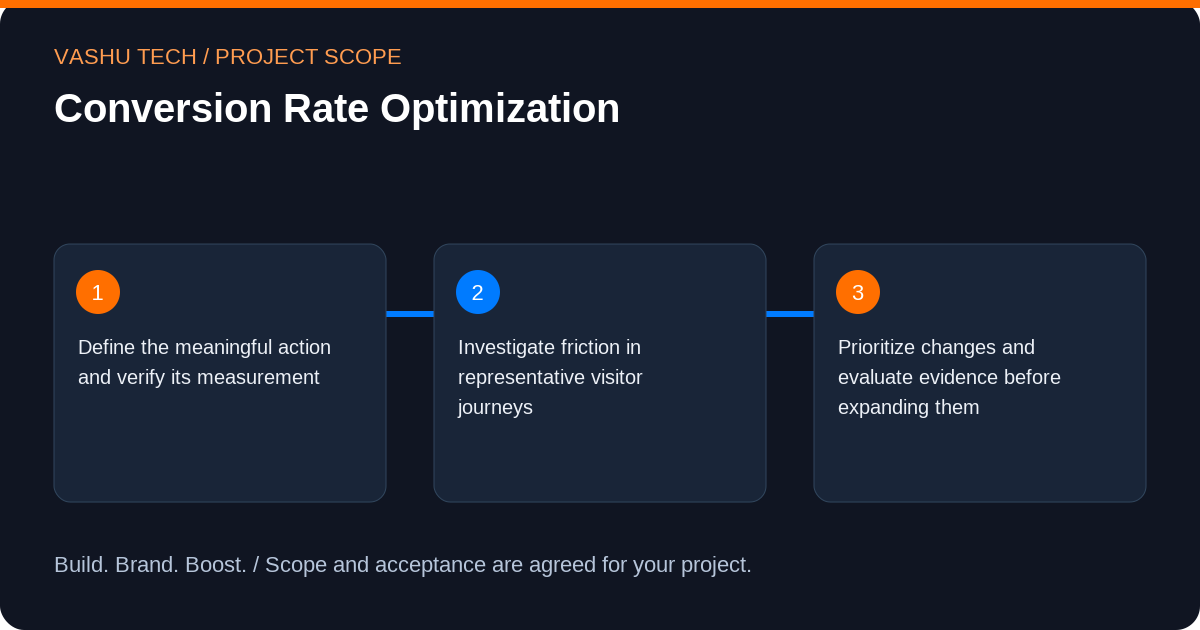
Use the Conversion Rate Optimization tasks as acceptance criteria: Define the meaningful action and verify its measurement; Investigate friction in representative visitor journeys; Prioritize changes and evaluate evidence before expanding them.
Choose the work relevant to your starting point. Final deliverables are agreed in your proposal.
For Conversion Rate Optimization, this stage covers define the meaningful action and verify its measurement. Agree the necessary inputs, intended output and review criteria before work starts.
For Conversion Rate Optimization, this stage covers investigate friction in representative visitor journeys. Agree the necessary inputs, intended output and review criteria before work starts.
For Conversion Rate Optimization, this stage covers prioritize changes and evaluate evidence before expanding them. Agree the necessary inputs, intended output and review criteria before work starts.
Broken validation, unclear costs or inconsistent navigation can affect completion, while a measurement error can make performance appear worse or better than it is.
Small samples and seasonal variation can distort tests. Avoid claiming that a single design change guarantees uplift. Qualitative review may be more useful than an experiment when traffic is limited.
Check the agreed Conversion Rate Optimization scope against representative examples. Confirm what is delivered, who maintains it and which follow-up tasks are separate.
Five practical stages from initial brief to reviewed handover.
Share the current situation, priority audience and the issue this Conversion Rate Optimization work should address.
Confirm define the meaningful action and verify its measurement, required inputs, dependencies and the agreed review points.
Carry out the approved scope, including investigate friction in representative visitor journeys, with changes reviewed against the brief.
Review audience, destination pages, approved creative and measurement settings. Advertising budgets and platform approval are separate.
Confirm acceptance of the Conversion Rate Optimization deliverables, ownership, documentation and any separately agreed ongoing support.
Confirm the included outputs before implementation; optional work is identified separately.
A written Conversion Rate Optimization brief covering the audience, current situation and priority: broken validation, unclear costs or inconsistent navigation can affect completion, while a measurement error can make performance appear worse or better than it is.
Define the meaningful action and verify its measurement; Investigate friction in representative visitor journeys; Prioritize changes and evaluate evidence before expanding them.
Review audience, destination pages, approved creative and measurement settings. Advertising budgets and platform approval are separate.
Small samples and seasonal variation can distort tests. Avoid claiming that a single design change guarantees uplift. Qualitative review may be more useful than an experiment when traffic is limited.
Check the agreed Conversion Rate Optimization tasks using real or approved representative examples, including relevant failure cases.
Confirm who maintains the result, how access is handed over and which improvements or support are outside the initial Conversion Rate Optimization agreement.
Choose the checks relevant to your Conversion Rate Optimization project; no ranking or business result is promised.
Where Conversion Rate Optimization affects public pages, organize accurate headings, service descriptions and useful links around the intended audience.
Review audience, destination pages, approved creative and measurement settings. Advertising budgets and platform approval are separate. Where applicable, include keyboard access, readable text and mobile interaction checks.
Agree how Conversion Rate Optimization work is evaluated. Separate implementation evidence from traffic, enquiries or sales, and configure analytics only where approved.
Discuss how Conversion Rate Optimization fits your audience, workflow and operational requirements.
Conversion optimization investigates where a website journey prevents a visitor from completing a useful action. It can combine usability review, technical checks and controlled experiments where the data supports them. The service is useful when a business has a defined conversion but does not understand the friction around it. A higher count is not automatically better if the action produces unsuitable or duplicate enquiries.
Marketing work needs a defined audience, offer and useful business action. Campaign setup, creative production, social publishing, ongoing advertising management and measurement are related but separate responsibilities. The destination page and enquiry follow-up should be ready before traffic is purchased. Account ownership, advertising spend and approval responsibilities need agreement. Measurement should distinguish visits, enquiries and qualified opportunities rather than treating them as the same result. Platform policies and privacy choices can affect implementation, and no campaign can responsibly promise a fixed return or lead volume.
Broken validation, unclear costs or inconsistent navigation can affect completion, while a measurement error can make performance appear worse or better than it is.
These stages describe the discussion scope for this service. The proposal should identify which outputs are included, the information required from you and any work that belongs to a separate agreement. Review points should make it possible to check the result against the original requirement.
Small samples and seasonal variation can distort tests. Avoid claiming that a single design change guarantees uplift. Qualitative review may be more useful than an experiment when traffic is limited.
The practical value is addressing this specific difficulty: broken validation, unclear costs or inconsistent navigation can affect completion, while a measurement error can make performance appear worse or better than it is. A useful result makes the relevant journey or operational responsibility clearer. Define the acceptance checks around prioritize changes and evaluate evidence before expanding them, and distinguish an implemented improvement from an unverified business outcome.
An estimate depends on the existing environment, the amount of content or data involved and the agreed testing and access requirements. External licences, hosting and vendor subscriptions should be identified separately. Share any deadline and its dependencies so that feasibility can be assessed; this page does not promise a fixed price or delivery date.
Describe the current situation and the change you need. A public website link and a short explanation are enough to begin; arrange sensitive access separately. Request a scoped quote or contact Vashu Tech to discuss the next step.
Define the audience, offer and business action before selecting channels. Separate creative production, publishing, paid advertising and reporting so the proposal identifies what is included. Landing-page readiness and enquiry follow-up matter alongside campaign settings; account access and spend approval should be agreed before advertising begins.
For Conversion Rate Optimization, start by identifying the decision or workflow you want to improve. Broken validation, unclear costs or inconsistent navigation can affect completion, while a measurement error can make performance appear worse or better than it is. Select the tasks that address that requirement; the full category of work does not have to be included in every project.
Useful starting information includes the offer, intended audience, approved brand assets, destination pages, account ownership and any budget constraints. Public links and redacted examples are enough for an initial discussion. Account access can be arranged separately after the required permissions are understood.
Consider a business promoting a new service. The brief could align the message in an advert with a clear destination page and a suitable enquiry route. Reporting should distinguish clicks from completed enquiries, and completed enquiries from opportunities the business considers relevant.
Translate that example into a small, testable brief for Conversion Rate Optimization: begin with define the meaningful action and verify its measurement, identify the inputs needed to investigate friction in representative visitor journeys, and agree how to prioritize changes and evaluate evidence before expanding them. This is an illustrative planning scenario, not a client case study or a promised result.
Review approved copy and creative, destination links, relevant tracking choices and the follow-up journey. Where advertising is included, clarify spend limits and who approves changes. Platform review, attribution gaps and audience response can affect outcomes; a fixed lead volume or return should not be assumed.
Keep a short acceptance checklist alongside the proposal. For this scope, the review should include: Define the meaningful action and verify its measurement; Investigate friction in representative visitor journeys; Prioritize changes and evaluate evidence before expanding them. Record what was checked, which items remain open and who can approve the result. An implemented change and a business outcome are different things; neither enquiries nor sales should be assumed from a technical demonstration.
The handover can cover approved assets, account ownership, reporting definitions and the responsibilities for continued publishing or advertising. Identify which recurring activities and media spend are included separately from initial setup.
Before handover, agree who owns the accounts, approves public information and handles future changes. Any maintenance, additional content, third-party subscription or ongoing campaign management should be listed explicitly in the proposal. Share an essential deadline early so dependencies can be discussed before a delivery schedule is agreed.
Conversion Rate Optimization should be scoped around the part of the business journey that needs attention. Broken validation, unclear costs or inconsistent navigation can affect completion, while a measurement error can make performance appear worse or better than it is. Describe the starting point before deciding whether the work requires a focused change, a new implementation or a wider review. Existing content, records and useful behaviour should be identified before any change is approved.
Marketing work needs a clear audience and a destination capable of supporting the intended action. Review the offer, content approvals and enquiry handling before choosing channels or buying traffic. Distinguish visits, submissions and qualified opportunities. Each is a different measurement. Establish account ownership and the review process for creative material so campaign decisions remain traceable and the business can maintain its assets.
Bring approved offer information, audience priorities, current channels and public destination pages. Identify who approves creative work and handles incoming enquiries. Explain available measurement and account access without sharing passwords in public forms. Advertising spend, provider charges and production costs should be visible as separate items. Agree what constitutes a useful business action before reporting results.
Identify the person who can approve public information and the person responsible for the operational result. Share public URLs and redacted examples first. Arrange sensitive access separately with suitable permissions. If there are deadlines, explain the event behind them and any approvals still needed. Ready content and verified account access can change the practical scope; they should be discussed before confirming the implementation plan.
A hypothetical business wants to promote a service but its destination page does not explain the scope or save enquiries reliably. The preparation can address the message, form and staff follow-up before a campaign is launched. This planning example does not imply a fixed lead volume or an existing client result.
For this service, adapt the example to Define the meaningful action and verify its measurement; Investigate friction in representative visitor journeys; Prioritize changes and evaluate evidence before expanding them. Identify the starting behaviour, expected change and the check that demonstrates the result. These are hypothetical planning situations, not claims about Vashu Tech clients or results. A useful example narrows the discussion to real requirements without assuming that every business needs the same features or the same amount of work.
Check approved creative, accurate destination content, valid links and the relevant submission journey. Review measurement configuration alongside privacy choices and account permissions. Distinguish test events from actual business activity. Record platform approvals and external delivery checks separately from the local setup. Reports should identify what the available evidence measures instead of presenting visits as completed sales.
Use a written checklist with a requirement, expected result and evidence for each important task. Include representative data and exceptions as well as the successful demonstration. Where work affects a visitor action, review the staff or administrative outcome too. Separate local verification, an authorised live release and ongoing operation. Record external-provider checks honestly instead of presenting entered configuration as proof that a real service has completed its work.
Define whether the work includes planning, asset production, setup, publishing or ongoing management. Advertising budgets, subscriptions and platform approval are separate from service fees. Creative reuse and content ownership need agreement. Performance depends on the offer, market and operational follow-up as well as implementation. Fixed returns, lead quantities and universal platform acceptance should not be promised.
The proposal should distinguish the initial outputs from content writing, new integrations, additional pages and ongoing support that are not included. Confirm ownership of accounts and files, documentation, ordinary editing tasks and the process for future changes. Agree how new requirements affect the estimate and schedule. Handover should make the result understandable to the responsible team, with unresolved dependencies recorded and a clear next step for each.
Audience, scope and coordination for Conversion Rate Optimization.
Businesses evaluating Conversion Rate Optimization for a new requirement or an existing website. Broken validation, unclear costs or inconsistent navigation can affect completion, while a measurement error can make performance appear worse or better than it is.
Define the meaningful action and verify its measurement Investigate friction in representative visitor journeys Prioritize changes and evaluate evidence before expanding them Scope, exclusions and acceptance evidence are agreed in the proposal.
Answers to help you plan the scope and next steps.
No. Reliable experiments need suitable traffic and measurement. Smaller sites may benefit more from fixing clear usability and technical problems first.
Include the affected website or proposed project, the audience and the outcome you need. For this work, useful discussion points include define the meaningful action and verify its measurement, investigate friction in representative visitor journeys, prioritize changes and evaluate evidence before expanding them. Do not send passwords in the public form.
The amount of existing work to inspect, the agreed deliverables, access readiness and testing requirements affect the estimate. Small samples and seasonal variation can distort tests. Avoid claiming that a single design change guarantees uplift. Qualitative review may be more useful than an experiment when traffic is limited. Ask for a scoped proposal rather than assuming a fixed package or completion date.
Acceptance should reflect the actual requirement: define the meaningful action and verify its measurement; investigate friction in representative visitor journeys; prioritize changes and evaluate evidence before expanding them. Check representative content and failure cases as well as the expected successful result. Agree the evidence and handover responsibilities before work begins.
Bring the offer, intended audience, approved brand assets, destination pages, account ownership and any budget constraints. Identify your priority and which tasks you need: Define the meaningful action and verify its measurement; Investigate friction in representative visitor journeys; Prioritize changes and evaluate evidence before expanding them. Share public or redacted information first; arrange sensitive access separately.
The handover can cover approved assets, account ownership, reporting definitions and the responsibilities for continued publishing or advertising. Identify which recurring activities and media spend are included separately from initial setup. Confirm account ownership, approval responsibilities and any ongoing support separately from the initial work.
Share your starting point and priorities. We can discuss the scope, required information and acceptance checks before providing an estimate.
Start a conversation
Send your requirements to our team. Please leave out passwords and confidential access details.