
Requirements first
Several pages can compete for the same intent while important topics are missing, making both navigation and search relevance less clear.
SEO work helps a website communicate its topics clearly and gives search engines reliable ways to discover public content. The scope can combine technical review, page organization and content improvement according to the site's current problems. It is useful when a business has useful information but inconsistent search signals or unclear page targeting. The work should prioritize visitor value rather than repeatedly inserting keywords into every section.
A clear scope, practical review points and communication around your actual requirements.
Several pages can compete for the same intent while important topics are missing, making both navigation and search relevance less clear.
For SEO Services, agree content ownership, access, approvals and the person who handles questions throughout the project.
Indexing and rankings depend on factors beyond a single implementation. Search Console access and a reliable baseline help assess changes. No service should guarantee a position or fabricate traffic results.
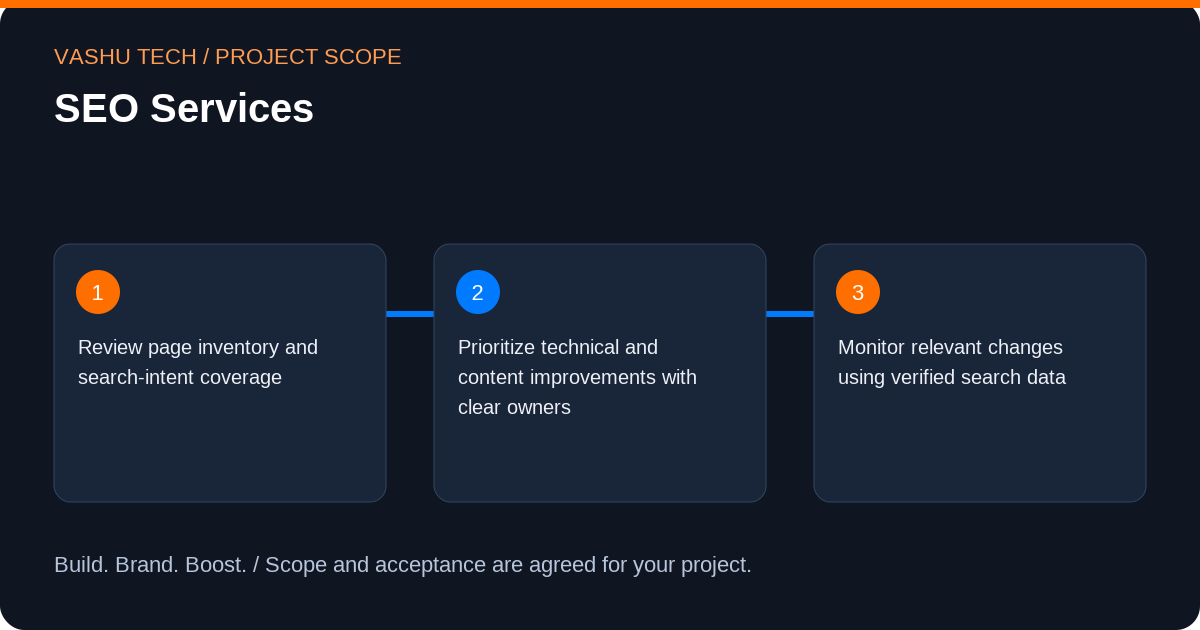
Use the SEO Services tasks as acceptance criteria: Review page inventory and search-intent coverage; Prioritize technical and content improvements with clear owners; Monitor relevant changes using verified search data.
Choose the work relevant to your starting point. Final deliverables are agreed in your proposal.
For SEO Services, this stage covers review page inventory and search-intent coverage. Agree the necessary inputs, intended output and review criteria before work starts.
For SEO Services, this stage covers prioritize technical and content improvements with clear owners. Agree the necessary inputs, intended output and review criteria before work starts.
For SEO Services, this stage covers monitor relevant changes using verified search data. Agree the necessary inputs, intended output and review criteria before work starts.
Several pages can compete for the same intent while important topics are missing, making both navigation and search relevance less clear.
Indexing and rankings depend on factors beyond a single implementation. Search Console access and a reliable baseline help assess changes. No service should guarantee a position or fabricate traffic results.
Check the agreed SEO Services scope against representative examples. Confirm what is delivered, who maintains it and which follow-up tasks are separate.
Five practical stages from initial brief to reviewed handover.
Share the current situation, priority audience and the issue this SEO Services work should address.
Confirm review page inventory and search-intent coverage, required inputs, dependencies and the agreed review points.
Carry out the approved scope, including prioritize technical and content improvements with clear owners, with changes reviewed against the brief.
Review crawl access, page relevance, internal links and available Search Console evidence. Rankings and traffic are not guaranteed.
Confirm acceptance of the SEO Services deliverables, ownership, documentation and any separately agreed ongoing support.
Confirm the included outputs before implementation; optional work is identified separately.
A written SEO Services brief covering the audience, current situation and priority: several pages can compete for the same intent while important topics are missing, making both navigation and search relevance less clear.
Review page inventory and search-intent coverage; Prioritize technical and content improvements with clear owners; Monitor relevant changes using verified search data.
Review crawl access, page relevance, internal links and available Search Console evidence. Rankings and traffic are not guaranteed.
Indexing and rankings depend on factors beyond a single implementation. Search Console access and a reliable baseline help assess changes. No service should guarantee a position or fabricate traffic results.
Check the agreed SEO Services tasks using real or approved representative examples, including relevant failure cases.
Confirm who maintains the result, how access is handed over and which improvements or support are outside the initial SEO Services agreement.
Choose the checks relevant to your SEO Services project; no ranking or business result is promised.
Where SEO Services affects public pages, organize accurate headings, service descriptions and useful links around the intended audience.
Review crawl access, page relevance, internal links and available Search Console evidence. Rankings and traffic are not guaranteed. Where applicable, include keyboard access, readable text and mobile interaction checks.
Agree how SEO Services work is evaluated. Separate implementation evidence from traffic, enquiries or sales, and configure analytics only where approved.
Discuss how SEO Services fits your audience, workflow and operational requirements.
A search review asks whether important information is accessible, clearly explained and connected to the rest of the website.
Technical implementation and editorial relevance need separate checks; one cannot reliably stand in for the other.
Blocked URLs, unclear topic boundaries or thin explanations may need different remedies. Investigation should establish the actual issue before prescribing more content.
An audit-only engagement should clearly identify who will implement its recommendations.
We can improve agreed content and technical signals, but indexing, rankings and traffic depend on factors beyond a single implementation.
Acceptance can confirm a corrected canonical, an accessible page or an improved explanation without claiming a guaranteed position in search results.
Site size, template complexity and the depth of investigation affect effort. Development fixes and continuing monitoring should be distinguished from the initial audit.
Provide the affected URLs and the searches or services you are concerned about. Request a scoped quote or contact Vashu Tech with the available search evidence.
Identify the priority service pages and markets before collecting a long list of unrelated keywords.
Record recent migrations or major content changes that may explain shifts in visibility.
Agree access through appropriate account permissions rather than sharing personal passwords.
Two pages may describe the same offer while using slightly different headings and nearly identical explanations.
Clarify their distinct purpose or plan consolidation carefully, including the effect on existing links.
Inspect response status, robots directives and canonical destinations for the agreed URL sample.
Check the actual deployed page because an edited CMS field may not be reflected correctly in its template.
Keep a dated change log alongside the issue register and relevant Search Console observations.
Give the content owner practical next actions rather than an unexplained export of crawler warnings.
A crawler can surface broken links, but page relevance requires reading what the business actually promises.
Structured data should describe visible facts and use a supported type appropriate to the page.
Share priority services, known competitors where useful and any authorised Search Console access.
Tell us which CMS or development owner can implement template and server-level recommendations.
A business may have detailed expertise offline while its public pages contain only short lists of labels.
Interviewing the owner can reveal scope details and practical answers that make those pages more useful.
Recheck affected URLs for their expected response, visible copy and relevant metadata.
Document remaining blockers so a partial implementation is not presented as a finished audit action.
Content production, link outreach, paid advertising and ongoing reporting are separate decisions unless explicitly included.
Review frequency should match the site activity and available evidence, with a named owner for follow-up work.
Audience, scope and coordination for SEO Services.
For site owners investigating missing pages, overlapping content, migration effects or weak relevance between their services and the pages customers reach.
An evidence-led issue list, prioritised changes and verification notes identifying which recommendations were implemented and which need another owner.
Answers to help you plan the scope and next steps.
No. The engagement defines the investigation and improvements we can deliver; search engines determine indexing and ranking.
It helps investigate search visibility and indexing evidence. Without it, the review can still inspect public technical signals but has less account-level context.
Implementation must be expressly included in the proposal. An audit can instead provide prioritised findings for your existing development team.
Separate pages make sense when the offers and customer questions differ meaningfully. Near-identical pages often need clearer boundaries or consolidation.
Supported structured data can help describe eligible content, but search features remain subject to platform requirements and selection.
Use a change log, verification notes and relevant search observations. Keep completed implementation separate from later movements in clicks or enquiries.
Share your starting point and priorities. We can discuss the scope, required information and acceptance checks before providing an estimate.
Start a conversation
Send your requirements to our team. Please leave out passwords and confidential access details.