Define routing rules, fallback ownership and staff visibility so website enquiries reach the team responsible for the request.
Map the business rule before automating it
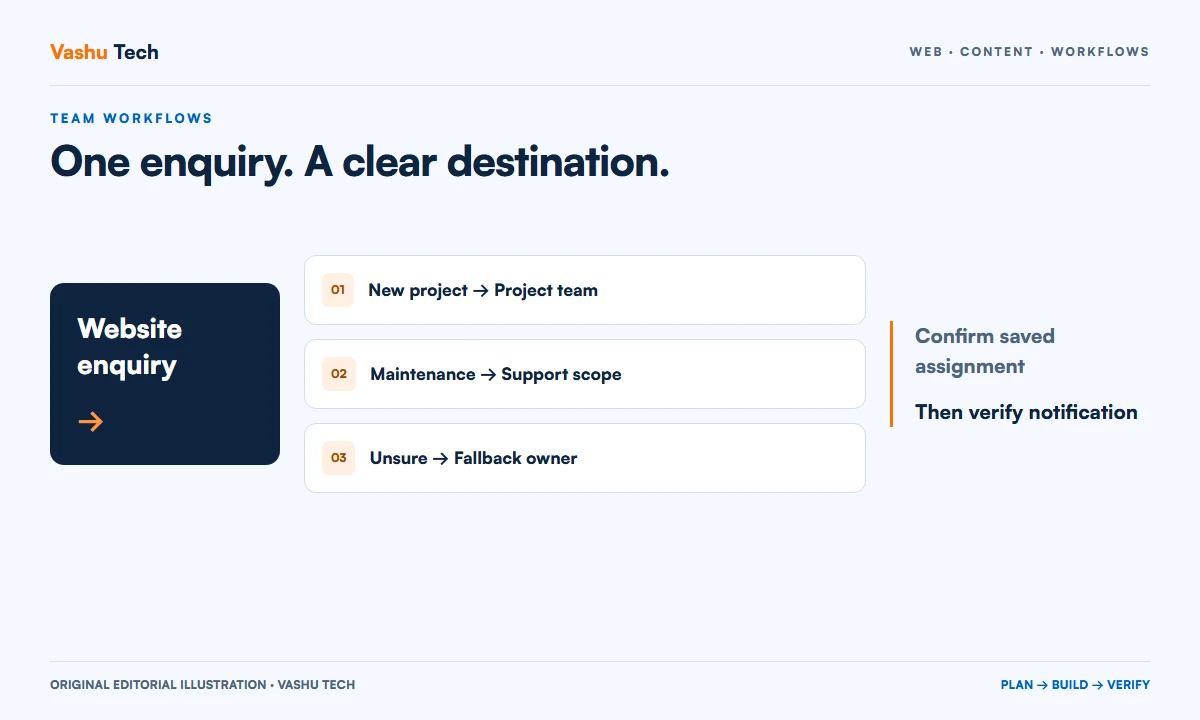
Enquiry routing becomes unreliable when the website tries to infer rules that the business has never agreed. Define whether requests are assigned by service, territory, existing account or another confirmed attribute. Use examples to resolve overlaps, such as a customer asking about two services in different regions.
Record the default destination for an unclassified request. The fallback owner should know they are responsible for reviewing it. A rule that handles ordinary cases but silently loses an unusual request is not a complete workflow.
Use explicit context carefully
A service selection or source page can help route a request, but it may not tell the whole story. A visitor on a New York page might be asking about a national project. Decide which information is authoritative and whether staff can correct the assignment after reading the message.
Keep the public form understandable. Customers should not need to know your internal department names to ask for help. If the business needs a classification that visitors cannot reliably supply, assign that step to staff rather than adding a confusing required field.
Separate assignment from access
Being notified about a request is different from having permission to view or change it. Define which team members can see assigned enquiries and whether managers need wider visibility. Include attachments and exports in that review. A notification should not accidentally expose private details to an unrelated recipient.
Specify what happens when the assigned person leaves or is unavailable. A team-owned queue may be appropriate in some businesses, while others require named ownership. Confirm the operating model instead of assuming one approach fits every organization.
Plan reliable fallbacks
Decide where accepted enquiries are stored and how staff can find requests when an email notification fails. Define duplicate handling and the response to incomplete routing data. Keep enough operational evidence to investigate a missed assignment without logging unnecessary sensitive content.
Prepare controlled tests for each routing branch, the default branch and an unauthorized account. Verify the saved owner and the actual notification recipient. A successful screen message does not demonstrate either of those outcomes.
Review the rules as the business changes
New services, territories and staff changes can make routing rules stale. Name the person responsible for updating them and include a check in the change process. Review a small sample of real assignments using the business's authorized reporting process rather than assuming that an old test remains sufficient.
For a routing repair or integration project, share the current rule examples and an anonymized failure case with Vashu Tech. That provides a concrete starting point for identifying the responsible form, application or receiving system.
Explore Website Integration Services or discuss your project with Vashu Tech.
Write routing rules as examples people can approve
Replace vague requirements such as send leads to the right person with a table of example requests and intended owners. Include the service, relevant context and reason for assignment. Ask the people operating the process to approve the examples. This reveals overlapping territories, unclear responsibilities and exceptions before they become hidden application behaviour.
Record which information the rule may rely on. A visitor's selected service can be more useful than an inferred location, while an existing account relationship may override a general territory rule. If several conditions apply, define their order. Do not let the implementation team quietly decide which business responsibility should take precedence.
Define the fallback as a normal part of the system
Some requests will not fit a rule: visitors choose unsure, describe several services or supply incomplete information. Give those requests a named destination with responsibility for triage. A fallback is not merely an error handler; it is the route that keeps unusual but legitimate enquiries visible to the business.
Explain what happens if a recipient is unavailable or no longer works with the team. Decide who maintains the route and how staff can reassign a request. If ownership changes after review, keep enough history to understand the handoff. A forwarding email chain alone may not provide a reliable record of who is responsible.
Keep customer context separate from internal classification
Public form options should use terms customers understand. Internal team codes, sales stages and territory exceptions may belong in staff tools. Asking visitors to perform internal classification can create inaccurate data and unnecessary friction. Collect the useful starting context and let the business make decisions that require specialist knowledge.
Retain the source page when it helps investigation, but do not assume it proves the customer's identity or location. A request made from a city page can concern a wider project. Keep the person's own description available to the receiving team so an automated route does not replace basic review of the actual requirement.
Plan receipt, notification and escalation separately
A request can be accepted by the application even when an email provider is delayed. Define where staff can find accepted records and which notification failure needs attention. If escalation or reminders are required, specify the trigger and responsible owner. Do not claim that a reminder exists simply because the system records a timestamp.
Agree what the visitor is told. A message confirming receipt should not promise that a particular staff member has read the request unless that is actually known. Keep notification content appropriate to the recipient's permissions. Avoid sending unnecessary personal details to a broad distribution list merely to increase the chance that someone notices the request.
Worked example: three services and an unsure option
Imagine a fictional company with new projects, maintenance and integrations. Each selection has an approved initial queue. Unsure requests go to a general triage owner, and a message involving several services can be reassigned after review. Existing customer status only affects the route when the business has a reliable, authorized way to establish it.
Acceptance includes each ordinary route, the unsure route, a repeated submission and a request that a restricted staff account must not access. The team confirms the saved assignment and actual notification recipient. This example demonstrates how to define the requirement; it is not a statement about a deployed Vashu Tech routing product.
Check changes against representative requests
When a service, territory or staff role changes, rerun a small set of approved examples. Review the route, visibility and notification outcome. A configuration update can alter who receives personal information, so it deserves more care than changing a display label. Keep a current owner for approving the rule change.
Use authorized reports or anonymized examples to investigate misroutes. Record the intended result and the actual result so the responsible component can be identified. The problem may lie in form context, the application rule, a receiving system or staff permissions. Fixing the correct layer prevents a cosmetic form edit from hiding an unresolved assignment problem.
Prepare a routing brief for implementation
Bring the current public forms, the proposed rule examples and a list of staff roles. Identify any receiving application and its account owner. Note which parts already work and which failures can be reproduced. Keep passwords and private customer records out of the public project description.
A scoped review can then separate form changes, assignment logic, notifications, access controls and external integration work. Ask for acceptance evidence for each included part. This makes completion reviewable and avoids a broad promise of automatic routing without a confirmed operational process.
A practical review checklist
- Approve example requests and their intended owners.
- Define rule precedence, unsure requests and fallback responsibility.
- Keep public customer language distinct from internal classification.
- Confirm saved assignment, authorized visibility and notification receipt.
- Test staff changes, reassignment and invalid routing context.
- Name an owner to review rules when the business changes.
Questions about putting this guide into practice
Can routing rely only on the source page?
The source page can provide context, but it may not represent the whole request. Decide whether a visible service selection or staff review should take precedence. Retain the original description so the receiving team can correct an assignment when needed.
Should every enquiry be emailed to everyone?
That may create noise and unnecessary exposure of personal information. Define who needs notification and who should have access to the saved request. A clear fallback owner is usually more reviewable than hoping a large recipient list will produce accountability.
How do we investigate a missing enquiry?
Separate acceptance, storage, assignment, staff permissions and notification. Use a controlled or appropriately authorized example and trace each step. Avoid assuming that an absent email means no record exists, or that a saved record proves the intended recipient was notified.
Plan your next step
Discuss a scoped project with Vashu Tech. Share your current website, intended audience and the specific task you want to improve. We can review the starting point, required inputs and acceptance checks before estimating the work.