
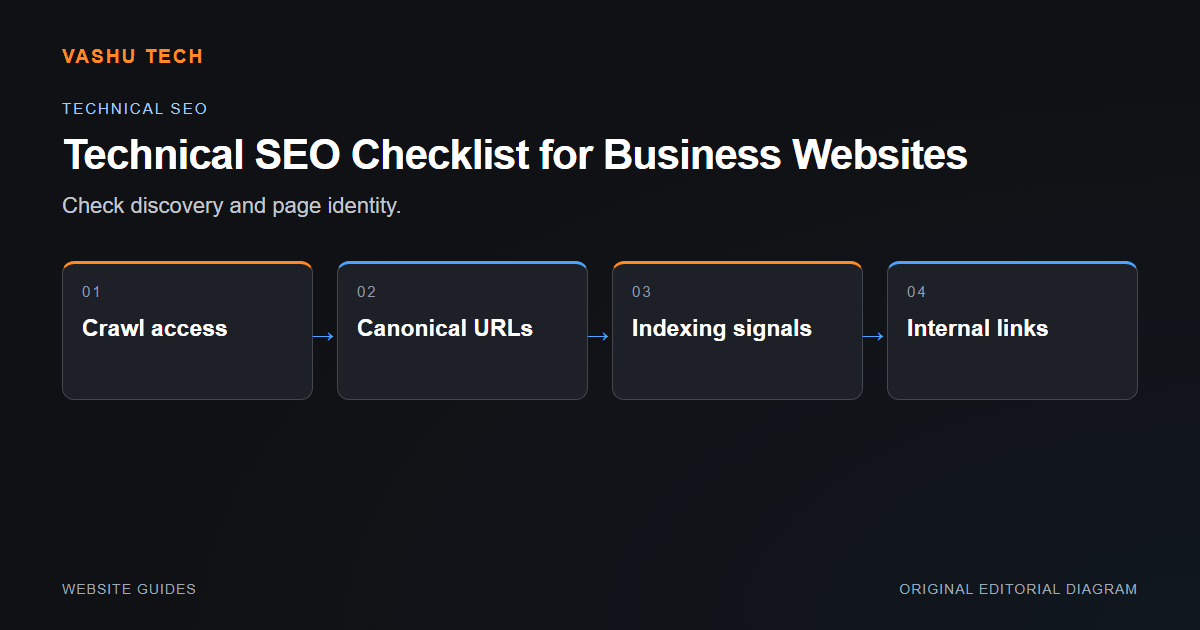
Technical SEO checks whether public pages send coherent discovery and indexing signals. A useful checklist starts with real URLs and the intended public/private boundary. It should explain the issue and validation method rather than treat every automated warning as an equally urgent problem.
Check access and identity signals
Review HTTP status, redirects, canonical URLs and robots directives on representative pages. A draft should not appear in public discovery files. An alternate canonical can exclude a URL from the intended sitemap even when the page itself loads. Keep staging and private previews protected independently of search crawler instructions.
Check what the page actually renders
Metadata and schema can be duplicated by templates, plugins or integrations. Inspect the rendered HTML instead of relying only on editor fields. Structured data should describe visible verified facts. Internal links should point to current public destinations, and sitemap URLs should use the final website origin.
Example: a published page is still noindex
The public status alone does not decide indexing. A page-level directive, environment configuration or conflicting template output may still prevent the intended signal. Check the complete response before rewriting the page's copy.
Project checklist
- Review status codes and redirects
- Check canonical and robots output
- Validate public sitemap eligibility
- Inspect rendered metadata and schema
- Keep private routes protected