
Requirements first
Apps or theme changes can emit conflicting metadata or duplicate structured data even when product editor fields appear correct.
Shopify SEO reviews the platform's product and collection routes, theme output and merchant content. It can address duplicate access paths, internal linking, metadata and product information within Shopify's supported controls. The service is useful when a store has a clear range but its important pages are difficult to discover or interpret. Theme and app behaviour need review alongside editor settings.
A clear scope, practical review points and communication around your actual requirements.
Apps or theme changes can emit conflicting metadata or duplicate structured data even when product editor fields appear correct.
For Shopify SEO, agree content ownership, access, approvals and the person who handles questions throughout the project.
Some URL and platform behaviour is not freely configurable. Work should distinguish supported controls from changes requiring theme code or an app. Product prices, availability and reviews must reflect real store data.
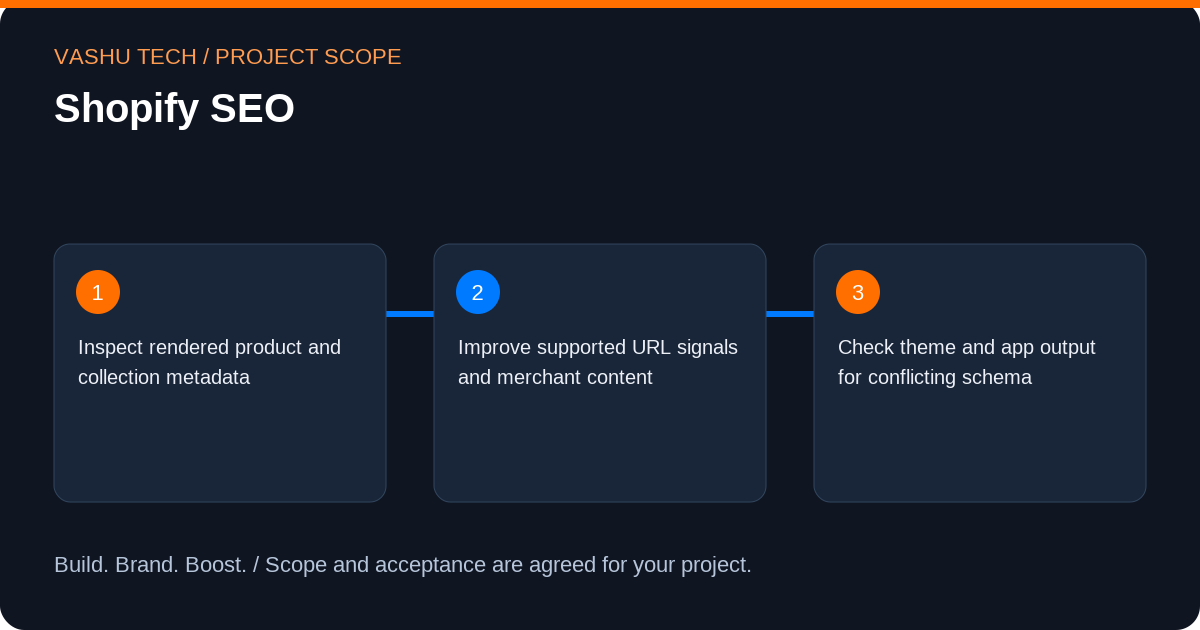
Use the Shopify SEO tasks as acceptance criteria: Inspect rendered product and collection metadata; Improve supported URL signals and merchant content; Check theme and app output for conflicting schema.
Choose the work relevant to your starting point. Final deliverables are agreed in your proposal.
For Shopify SEO, this stage covers inspect rendered product and collection metadata. Agree the necessary inputs, intended output and review criteria before work starts.
For Shopify SEO, this stage covers improve supported URL signals and merchant content. Agree the necessary inputs, intended output and review criteria before work starts.
For Shopify SEO, this stage covers check theme and app output for conflicting schema. Agree the necessary inputs, intended output and review criteria before work starts.
Apps or theme changes can emit conflicting metadata or duplicate structured data even when product editor fields appear correct.
Some URL and platform behaviour is not freely configurable. Work should distinguish supported controls from changes requiring theme code or an app. Product prices, availability and reviews must reflect real store data.
Check the agreed Shopify SEO scope against representative examples. Confirm what is delivered, who maintains it and which follow-up tasks are separate.
Five practical stages from initial brief to reviewed handover.
Share the current situation, priority audience and the issue this Shopify SEO work should address.
Confirm inspect rendered product and collection metadata, required inputs, dependencies and the agreed review points.
Carry out the approved scope, including improve supported URL signals and merchant content, with changes reviewed against the brief.
Review crawl access, page relevance, internal links and available Search Console evidence. Rankings and traffic are not guaranteed.
Confirm acceptance of the Shopify SEO deliverables, ownership, documentation and any separately agreed ongoing support.
Confirm the included outputs before implementation; optional work is identified separately.
A written Shopify SEO brief covering the audience, current situation and priority: apps or theme changes can emit conflicting metadata or duplicate structured data even when product editor fields appear correct.
Inspect rendered product and collection metadata; Improve supported URL signals and merchant content; Check theme and app output for conflicting schema.
Review crawl access, page relevance, internal links and available Search Console evidence. Rankings and traffic are not guaranteed.
Some URL and platform behaviour is not freely configurable. Work should distinguish supported controls from changes requiring theme code or an app. Product prices, availability and reviews must reflect real store data.
Check the agreed Shopify SEO tasks using real or approved representative examples, including relevant failure cases.
Confirm who maintains the result, how access is handed over and which improvements or support are outside the initial Shopify SEO agreement.
Choose the checks relevant to your Shopify SEO project; no ranking or business result is promised.
Where Shopify SEO affects public pages, organize accurate headings, service descriptions and useful links around the intended audience.
Review crawl access, page relevance, internal links and available Search Console evidence. Rankings and traffic are not guaranteed. Where applicable, include keyboard access, readable text and mobile interaction checks.
Agree how Shopify SEO work is evaluated. Separate implementation evidence from traffic, enquiries or sales, and configure analytics only where approved.
Discuss how Shopify SEO fits your audience, workflow and operational requirements.
Shopify SEO reviews the platform's product and collection routes, theme output and merchant content. It can address duplicate access paths, internal linking, metadata and product information within Shopify's supported controls. The service is useful when a store has a clear range but its important pages are difficult to discover or interpret. Theme and app behaviour need review alongside editor settings.
Search optimization combines useful explanations with reliable technical signals. A page should have a distinct purpose, a clear title and links that help a visitor understand its relationship to other content. Technical investigation may reveal indexing directives, duplicate URLs or migration problems; content work may reveal an unanswered customer question. Local and international pages need accurate information and a real audience difference. Neither a plugin score nor a large number of pages guarantees visibility. Priorities should be based on the website and verified search evidence where it is available.
Apps or theme changes can emit conflicting metadata or duplicate structured data even when product editor fields appear correct.
These stages describe the discussion scope for this service. The proposal should identify which outputs are included, the information required from you and any work that belongs to a separate agreement. Review points should make it possible to check the result against the original requirement.
Some URL and platform behaviour is not freely configurable. Work should distinguish supported controls from changes requiring theme code or an app. Product prices, availability and reviews must reflect real store data.
The practical value is addressing this specific difficulty: apps or theme changes can emit conflicting metadata or duplicate structured data even when product editor fields appear correct. A useful result makes the relevant journey or operational responsibility clearer. Define the acceptance checks around check theme and app output for conflicting schema, and distinguish an implemented improvement from an unverified business outcome.
An estimate depends on the existing environment, the amount of content or data involved and the agreed testing and access requirements. External licences, hosting and vendor subscriptions should be identified separately. Share any deadline and its dependencies so that feasibility can be assessed; this page does not promise a fixed price or delivery date.
Describe the current situation and the change you need. A public website link and a short explanation are enough to begin; arrange sensitive access separately. Request a scoped quote or contact Vashu Tech to discuss the next step.
Start with the purpose of each page and evidence of the current website condition. Indexing, technical issues, content gaps and local service information are different concerns. Prioritize changes that clarify useful information and remove an identified obstacle rather than treating a keyword list or plugin score as a complete strategy.
For Shopify SEO, start by identifying the decision or workflow you want to improve. Apps or theme changes can emit conflicting metadata or duplicate structured data even when product editor fields appear correct. Select the tasks that address that requirement; the full category of work does not have to be included in every project.
Useful starting information includes the public website, priority services, confirmed service areas, recent changes and any search reports you can share safely. Public links and redacted examples are enough for an initial discussion. Account access can be arranged separately after the required permissions are understood.
Consider two pages explaining the same service in almost identical language. A practical review could decide whether each serves a different audience, whether one stronger page is appropriate and how internal links should guide visitors. Location content should explain genuine service arrangements rather than imply an office that does not exist.
Translate that example into a small, testable brief for Shopify SEO: begin with inspect rendered product and collection metadata, identify the inputs needed to improve supported URL signals and merchant content, and agree how to check theme and app output for conflicting schema. This is an illustrative planning scenario, not a client case study or a promised result.
Review the changed pages, canonical signals, indexing directives, internal links and structured data against visible content. Clear answers and accurate organization information support machine understanding, but markup alone does not guarantee search features, rankings or inclusion in AI-generated answers.
Keep a short acceptance checklist alongside the proposal. For this scope, the review should include: Inspect rendered product and collection metadata; Improve supported URL signals and merchant content; Check theme and app output for conflicting schema. Record what was checked, which items remain open and who can approve the result. An implemented change and a business outcome are different things; neither enquiries nor sales should be assumed from a technical demonstration.
The handover can include the agreed findings, completed changes and priorities that remain open. Define how future content and technical changes will be reviewed and which reporting sources are available; results need observation over time rather than a launch-day promise.
Before handover, agree who owns the accounts, approves public information and handles future changes. Any maintenance, additional content, third-party subscription or ongoing campaign management should be listed explicitly in the proposal. Share an essential deadline early so dependencies can be discussed before a delivery schedule is agreed.
Shopify SEO should be scoped around the part of the business journey that needs attention. Apps or theme changes can emit conflicting metadata or duplicate structured data even when product editor fields appear correct. Describe the starting point before deciding whether the work requires a focused change, a new implementation or a wider review. Existing content, records and useful behaviour should be identified before any change is approved.
SEO work should begin with page purpose and verified technical output. Distinguish crawl access, indexing intent, duplication and unclear content instead of treating them as one keyword problem. Prioritise findings that affect important public pages. Where search-account access is authorised, compare it with the rendered website. A plugin score or a parseable structured-data block does not establish ranking, indexing or eligibility for a search feature.
Share the website, priority services or topics, known changes and the URLs that need review. Identify the intended audience and accurate business information. Provide authorised Search Console or measurement access only through an appropriate process when it is needed. Explain previous migrations and custom canonical decisions. Existing content and redirects should be inspected before consolidation or URL changes are proposed.
Identify the person who can approve public information and the person responsible for the operational result. Share public URLs and redacted examples first. Arrange sensitive access separately with suitable permissions. If there are deadlines, explain the event behind them and any approvals still needed. Ready content and verified account access can change the practical scope; they should be discussed before confirming the implementation plan.
A hypothetical service site has two pages describing the same scope and a sitemap containing a private draft. A targeted review can clarify the page purposes and fix public eligibility. The work is checked through actual responses, metadata and links; it does not claim an immediate ranking improvement from those technical corrections.
For this service, adapt the example to Inspect rendered product and collection metadata; Improve supported URL signals and merchant content; Check theme and app output for conflicting schema. Identify the starting behaviour, expected change and the check that demonstrates the result. These are hypothetical planning situations, not claims about Vashu Tech clients or results. A useful example narrows the discussion to real requirements without assuming that every business needs the same features or the same amount of work.
Compare expected public URLs with responses, robots directives, canonical output and discovery documents. Review meaningful headings, descriptions, internal links and accurate structured data for affected templates. Retest representative publication states and content lengths. Document which results are reproducible implementation checks and which require later external evidence. Search processing, rankings and rich-result appearance are outside the control of a local code demonstration.
Use a written checklist with a requirement, expected result and evidence for each important task. Include representative data and exceptions as well as the successful demonstration. Where work affects a visitor action, review the staff or administrative outcome too. Separate local verification, an authorised live release and ongoing operation. Record external-provider checks honestly instead of presenting entered configuration as proof that a real service has completed its work.
Confirm whether the agreement includes an audit, implementation, content production or continued monitoring. Account setup, historical analytics availability and search-engine processing are separate dependencies. Do not invent geographic presence, reviews or achievements to fill metadata. Content should be accurate and distinct. No responsible scope can guarantee a particular ranking, traffic volume or indexing date.
The proposal should distinguish the initial outputs from content writing, new integrations, additional pages and ongoing support that are not included. Confirm ownership of accounts and files, documentation, ordinary editing tasks and the process for future changes. Agree how new requirements affect the estimate and schedule. Handover should make the result understandable to the responsible team, with unresolved dependencies recorded and a clear next step for each.
Audience, scope and coordination for Shopify SEO.
Businesses evaluating Shopify SEO for a new requirement or an existing website. Apps or theme changes can emit conflicting metadata or duplicate structured data even when product editor fields appear correct.
Inspect rendered product and collection metadata Improve supported URL signals and merchant content Check theme and app output for conflicting schema Scope, exclusions and acceptance evidence are agreed in the proposal.
Answers to help you plan the scope and next steps.
No. The platform defines parts of its route structure. Improvements should work with supported controls rather than promise unrestricted URL rewriting.
Include the affected website or proposed project, the audience and the outcome you need. For this work, useful discussion points include inspect rendered product and collection metadata, improve supported url signals and merchant content, check theme and app output for conflicting schema. Do not send passwords in the public form.
The amount of existing work to inspect, the agreed deliverables, access readiness and testing requirements affect the estimate. Some URL and platform behaviour is not freely configurable. Work should distinguish supported controls from changes requiring theme code or an app. Product prices, availability and reviews must reflect real store data. Ask for a scoped proposal rather than assuming a fixed package or completion date.
Acceptance should reflect the actual requirement: inspect rendered product and collection metadata; improve supported url signals and merchant content; check theme and app output for conflicting schema. Check representative content and failure cases as well as the expected successful result. Agree the evidence and handover responsibilities before work begins.
Bring the public website, priority services, confirmed service areas, recent changes and any search reports you can share safely. Identify your priority and which tasks you need: Inspect rendered product and collection metadata; Improve supported URL signals and merchant content; Check theme and app output for conflicting schema. Share public or redacted information first; arrange sensitive access separately.
The handover can include the agreed findings, completed changes and priorities that remain open. Define how future content and technical changes will be reviewed and which reporting sources are available; results need observation over time rather than a launch-day promise. Confirm account ownership, approval responsibilities and any ongoing support separately from the initial work.
Share your starting point and priorities. We can discuss the scope, required information and acceptance checks before providing an estimate.
Start a conversation
Send your requirements to our team. Please leave out passwords and confidential access details.