
Remote website design and development for San Diego businesses, including focused landing pages and clearly defined enquiry journeys.
Areas we serve
Web Design & Development in San Diego
Remote website design and development for San Diego businesses, including focused landing pages and clearly defined enquiry journeys.
Scope-ledYour requirements first
Clear estimatesBased on agreed work
Review pointsDefine acceptance checks
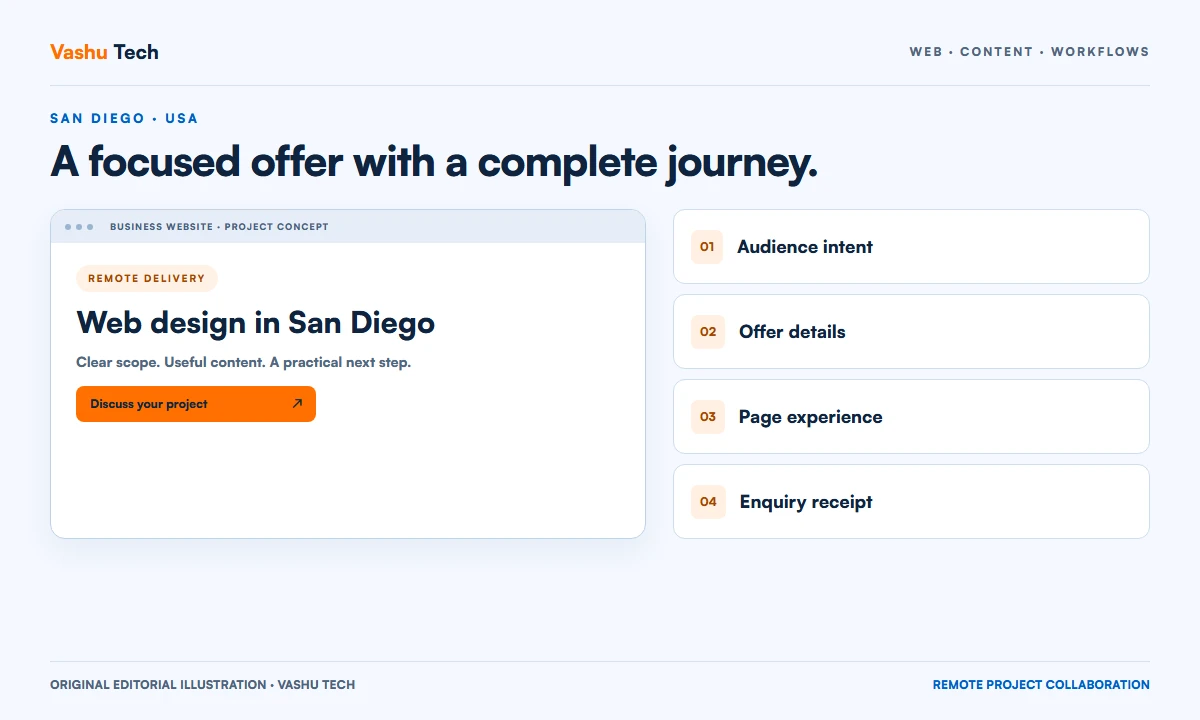
Explore this page Services, project examples and delivery details
02
Your project requirements
03
Match the page to the intended audience
A focused landing page and a full business website solve different requirements. A San Diego company introducing one offer may need a concise page with a clear action, while a broader service business may need several audience pathways. Vashu Tech can discuss the appropriate scope before design begins.
Bring the offer, intended visitors and the information they need to decide whether to contact you. Campaign assumptions should be stated clearly. A page design cannot guarantee enquiries or compensate for an undefined service proposition.
04
Plan the destination before sending traffic
The page should explain the offer, its boundaries and the next step. Confirm approved copy, image rights and any commercial conditions. Decide where the enquiry should go and who will handle it before relying on a campaign to generate interest.
Measurement is a separate implementation and account discussion. Define the action the business wants to observe and use only approved tracking arrangements. Do not treat a button click as proof of a qualified opportunity or promise provider receipt without verification.
05
Build reusable and responsive content
A maintainable page uses components that can accommodate real headings, images and error messages. Review the smaller screen experience and keyboard use alongside desktop presentation. If the page belongs to an existing website, preserve relevant navigation and design conventions.
An existing WordPress setup may support the requirement through a focused change. More specialized functionality may need a separate review. Hosting, third-party tools and ongoing publishing responsibilities should be identified in the proposal.
06
Agree acceptance and handover
Use remote milestones, consolidated feedback and confirmed Pacific Time meetings. Test the complete enquiry journey, including accepted and invalid submissions, staff receipt and confirmation. Record any external account setup still needed before launch.
Share the proposed offer or current page with Vashu Tech for a scoped discussion. The estimate can distinguish content preparation, design, development and measurement instead of leaving those responsibilities unclear.
07
Explore service scopes
08
Discuss your San Diego project
Request a scoped quote with your website, intended audience and required change. Do not send passwords through the public form.
09
A project scenario for a focused campaign destination
Imagine a fictional San Diego consultancy introducing one clearly defined service. It needs a page that matches the audience and explains the offer, while the main business website remains in place. A scoped project could create that destination and a complete enquiry journey without assuming the company needs an immediate full-site replacement.
Bring the audience, approved offer and intended next action. Identify any campaign or external account owner involved. The page can then be reviewed against a specific purpose rather than a general request to make it convert. This scenario is illustrative and does not claim a client result, advertising performance or provider setup.
10
Resolve the offer before polishing the layout
Explain who the service suits, what is included and which questions require a discussion. The headline, supporting copy and enquiry action should agree. If a condition matters to eligibility, place it where the visitor can understand it before submitting a detailed request. A visual design should not conceal an unresolved business rule.
Use approved evidence when available and keep examples labelled as examples. Do not fill a testimonial area with invented praise or imply that a reference image is completed work. The proposal should identify whether copywriting, asset preparation and offer review are included or supplied by the business.
11
Scope measurement as an operational dependency
Decide what the team needs to observe and which approved account or tool supplies it. A page visit, an action click, a saved enquiry and a qualified opportunity mean different things. A design or development project should not promise a business outcome based only on an interface event.
If tracking is included, confirm the account owner and implementation requirements. Report what was actually checked and what remains dependent on provider configuration. Keep the page functional when optional tracking is unavailable, and do not treat an unconfigured external connection as completed merely because a field exists in settings.
12
Build a destination that belongs to the existing site
Preserve appropriate navigation, brand components and contact routes when adding a page to a current website. Test long content and the phone experience. A focused campaign page should still make the business and offer understandable rather than leaving visitors on an isolated screen with little context.
Acceptance can include approved copy, responsive layout, controlled form submission, staff receipt and any agreed measurement check. Identify hosting, licences and campaign operations separately. Handover should explain how the offer is updated and who reviews it when conditions change.
13
Choose the right website scope before choosing features
Website design addresses the hierarchy, presentation and interactions that help visitors understand an offer. Development implements the templates, forms and selected functionality. A WordPress project may emphasize editing and supported customization, while a Laravel application may be appropriate for confirmed roles or specialized workflows. The choice should follow the requirement and the existing environment rather than a preference for the largest build.
Bring a representative user journey to the discussion. Explain who visits, what they need to understand and what should happen after an action. If the current website already supports that journey, a focused improvement may be enough. If it does not, identify the gap before deciding which platform or feature belongs in the proposal.
14
Discovery, design and implementation milestones
A practical discovery stage records the audience, page inventory, content owners and operational dependencies. Design review then uses representative copy to establish the page hierarchy and reusable components. Implementation follows the agreed behaviour, including validation and staff-facing responsibilities. The precise stages depend on the selected work; they are a planning framework, not a promise that every project includes every service.
At each milestone, name the reviewer and the decision needed to continue. Keep a short record of approved work and open questions. Missing copy, account access or business rules can affect the schedule. Making those dependencies visible is more useful than agreeing a launch date that assumes they have already been resolved.
15
Content, images and accessible interaction
Use approved service information and images that explain the page's actual subject. A relevant original diagram can show a workflow without implying a completed client project. Photographs need appropriate rights and accurate context. Keep alternative text meaningful, preserve readable type and review the layout with real headings rather than short placeholders.
Motion should guide attention without making essential information depend on an effect. The page needs to remain understandable with reduced motion and on smaller screens. Review keyboard operation, visible controls and helpful form feedback alongside visual polish. These checks support usable delivery; they do not establish a legal compliance certification or a business outcome.
16
Test the customer journey and the receiving workflow
Acceptance should follow a realistic visitor from the relevant service explanation to an appropriate next step. For a form, check valid input, invalid input and correction. Confirm that the application accepts the request and that the intended staff role can find it. Where notification is included, verify that separately instead of assuming a success message proves email delivery.
Use controlled examples and coordinate tests with the people receiving them. Check representative phone, tablet and desktop layouts, important links and the editing tasks that belong in handover. Record what was actually exercised and any provider or account dependency that remains. A reviewable result explains both the implementation and its practical limits.
17
Understand estimates, exclusions and ongoing responsibility
The current website, selected page types, content volume, integrations and verification requirements influence the estimate. Domain registration, hosting, commercial licences, advertising spend and ongoing support can be separate costs. Ask the proposal to identify them explicitly. A request for a quote begins a scope discussion; it does not establish a fixed price or automatic project availability.
After launch, name the owners of accounts, content updates and maintenance. Handover should demonstrate routine tasks and identify work that still needs technical support. Recovery and backup responsibilities should reflect the actual environment. These operational details help the business maintain the website instead of receiving an attractive interface with unclear ownership.
18
Prepare a useful remote project brief
Send the public website address or a short outline of the proposed site, your main audience and the change you need. Include representative services, examples of current difficulties and any real deadline. Explain who will supply copy and approve the work. If integrations are involved, name the system and account owner without placing credentials in the public form.
Confirm a communication channel and suitable review window with the delivery team. Keep decisions and feedback available in writing between meetings. The city-specific information on this page describes a remote service arrangement and planning examples; it does not establish local premises, past clients, guaranteed response times or a promised ranking. Those boundaries keep the project discussion accurate and useful.
19
A practical review checklist
- Define the audience, approved offer and intended next action.
- Confirm eligibility wording and supporting asset ownership.
- Identify the existing site conventions the page should retain.
- Separate page delivery from advertising and provider configuration.
- Agree Pacific Time reviews and a single approval owner.
- Test the complete enquiry path and any explicitly included measurement.
20
Plan your next step
Discuss a scoped project with Vashu Tech. Share your current website, intended audience and the specific task you want to improve. We can review the starting point, required inputs and acceptance checks before estimating the work.
21
Planning the right fit
Audience, scope and coordination for Web Design and Development in San Diego.
Who this is for
San Diego consultancies, service brands and small teams planning a business website or a focused campaign destination.
Scope and deliverables
Agreed page structure and content responsibilities. Responsive design and selected development work. Enquiry-path verification and an agreed handover. Exact inclusions, costs and support are confirmed in the proposal.
Working in your area
Confirm an available Pacific Time review window with your San Diego team. Work is remote, and no San Diego premises or local attendance are claimed.
22
Questions about Web Design and Development in San Diego
Answers to help you plan the scope and next steps.
Does Vashu Tech have an office in San Diego?
This page describes remote services for businesses in San Diego, California, USA. It does not claim a local office or on-site attendance.
What affects the project cost and schedule?
The current website, confirmed deliverables, content readiness, integrations and review requirements determine the estimate. Hosting, licences and ongoing support are identified separately.
How do we begin a remote project?
Share your website or project outline, audience and intended outcome. We can discuss the scope, communication schedule and acceptance checks before providing a proposal. Do not send passwords through the public enquiry form.
Can we add one landing page to the current website?
Often that can be evaluated as a focused scope. The existing platform, navigation and enquiry workflow should be reviewed first. A full redesign is only appropriate when the broader requirement supports it.
Does landing-page development include campaign management?
Only when that work is explicitly included. Page design, advertising accounts, campaign spend and ongoing management are related but separate responsibilities. Confirm the scope and account ownership rather than assuming one request includes every activity.
Discuss your requirements
Plan your Web Design and Development in San Diego project
Share your starting point and priorities. We can discuss the scope, required information and acceptance checks before providing an estimate.
Start a conversation
Tell us about your project.
Send your requirements to our team. Please leave out passwords and confidential access details.