
Remote website design and development for New York businesses, with clear service pages, enquiry workflows and content ownership.
Areas we serve
Web Design & Development in New York
Remote website design and development for New York businesses, with clear service pages, enquiry workflows and content ownership.
Scope-ledYour requirements first
Clear estimatesBased on agreed work
Review pointsDefine acceptance checks
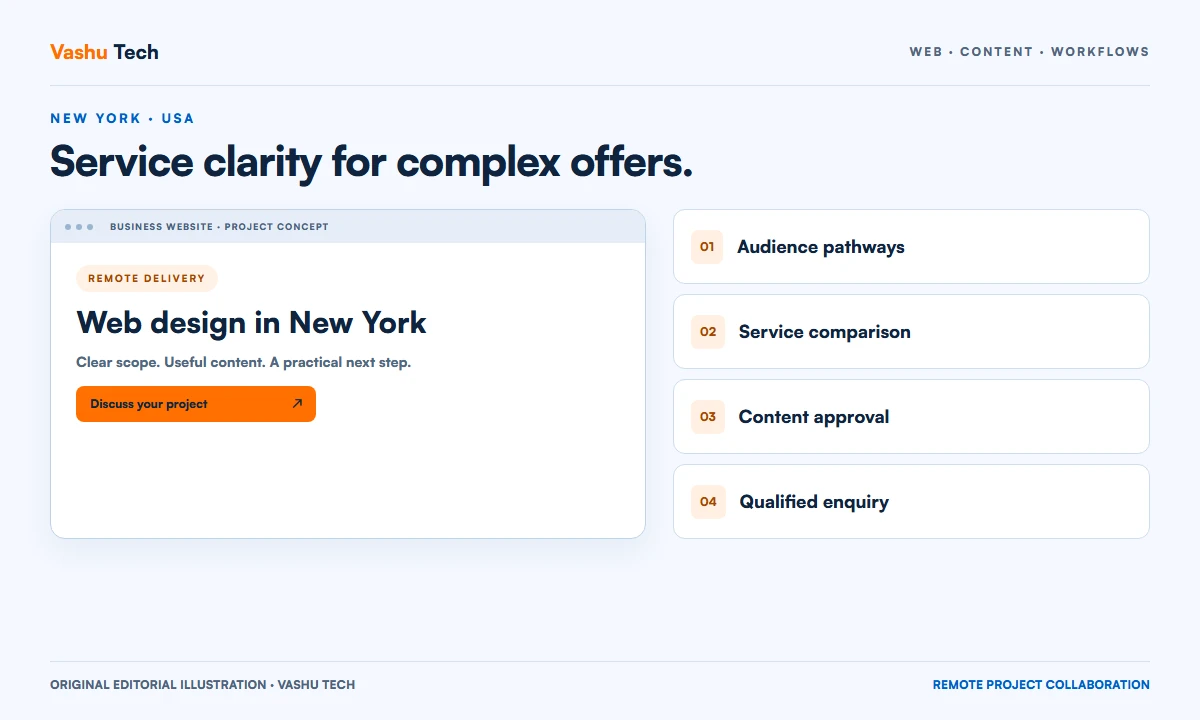
Explore this page Services, project examples and delivery details
02
Your project requirements
03
A clear website for a complex service offer
A New York business with several service lines needs visitors to find the relevant offer without navigating an internal organization chart. Vashu Tech can discuss a website structure that separates audiences, explains the work and gives each page a purposeful next step. The starting point is your current website, approved services and the questions prospective customers ask.
For a consultancy, a useful brief might distinguish an initial advisory engagement from ongoing implementation. Those are example scopes, not claims about previous clients. The content should explain the difference in plain language and help a visitor request the right discussion.
04
Design, development and publishing scope
A project can cover page planning, responsive layouts, editable content and validated enquiry forms. Existing WordPress websites may need a focused theme or workflow change instead of a rebuild. A specialized customer or staff process may need a separate application review. The proposal should identify the selected work and its dependencies.
Bring representative copy, brand materials and the names of the people approving them. If several departments review content, agree one owner to consolidate feedback. This makes design review more useful than a collection of conflicting page comments.
05
Coordinate a remote project with your team
Agree review dates, communication channels and an overlap window before the project begins. Record decisions so work can continue when participants are offline. Do not assume an immediate response or a particular support schedule; availability and ongoing support belong in the agreed scope.
Sensitive account access should follow a separate secure process. A public enquiry needs only a website address, an outline of the requirement and the best way to contact you. Avoid sending passwords or customer records through the quote form.
06
Check the enquiry journey before release
Review whether a phone visitor can find a service, understand its boundaries and submit a useful request. Confirm that accepted enquiries reach the intended staff workflow and that error messages explain how to correct input. Include keyboard use, long content and representative smaller screens.
Handover should name the content owner, account owners and maintenance responsibilities. Estimates depend on the existing system and confirmed deliverables. Request a scoped discussion rather than assuming a fixed price, launch date or search result.
07
Explore service scopes
08
Discuss your New York project
Request a scoped quote with your website, intended audience and required change. Do not send passwords through the public form.
09
A project scenario for a multi-service consultancy
Consider a fictional New York consultancy with advisory and implementation services. Its website currently describes both in one long page, so prospective buyers struggle to identify the right starting point. A useful project could separate the two scopes, explain their relationship and provide an enquiry route that allows the visitor to describe uncertainty. This is a planning example, not a claim about a completed client project.
The brief would include the questions buyers ask, the approved service boundaries and the staff receiving requests. A page map can then connect an overview to detailed explanations without duplicating the same copy. The first design review should use real service names and realistic text so content length does not become a late surprise.
10
Coordinate several reviewers without competing versions
A professional team may need service owners to confirm facts and a marketing owner to approve presentation. Name one person to consolidate decisions. Keep factual corrections distinct from design preferences so the implementation team knows which changes affect the offer. Record approved terminology and unresolved claims before extending the layout across the site.
Agree a current reference for copy and a review date for each page group. If a service changes after approval, check navigation, forms and related pages as well as the paragraph being edited. A small decision record is often more useful than an elaborate approval tool that nobody maintains.
11
Create distinct routes for different buyer questions
A first-time buyer may need an overview, while an existing contact may want a specific capability or a way to send a project outline. Review those journeys separately. The website can provide both without treating every visitor as ready to request a full proposal. Links should explain where they lead and keep essential service information easy to find.
For the enquiry journey, decide which context is helpful and which questions belong in a later conversation. Avoid interpreting a visit to the New York page as proof that the entire project is local. A company can coordinate work across multiple locations, so the customer's description remains important.
12
What a scoped proposal should make clear
For this kind of website, ask the proposal to identify page types, content responsibilities, form routing, editorial access and acceptance examples. If the site connects to a customer system, describe that connection separately from ordinary page development. Confirm the owner of each receiving account before an integration is treated as available.
A practical release review checks service comparison on a phone, a controlled enquiry and a routine staff content edit. It also checks the approved copy on the actual pages. These deliverables can be discussed without promising a particular lead volume, search ranking or commercial result.
13
Choose the right website scope before choosing features
Website design addresses the hierarchy, presentation and interactions that help visitors understand an offer. Development implements the templates, forms and selected functionality. A WordPress project may emphasize editing and supported customization, while a Laravel application may be appropriate for confirmed roles or specialized workflows. The choice should follow the requirement and the existing environment rather than a preference for the largest build.
Bring a representative user journey to the discussion. Explain who visits, what they need to understand and what should happen after an action. If the current website already supports that journey, a focused improvement may be enough. If it does not, identify the gap before deciding which platform or feature belongs in the proposal.
14
Discovery, design and implementation milestones
A practical discovery stage records the audience, page inventory, content owners and operational dependencies. Design review then uses representative copy to establish the page hierarchy and reusable components. Implementation follows the agreed behaviour, including validation and staff-facing responsibilities. The precise stages depend on the selected work; they are a planning framework, not a promise that every project includes every service.
At each milestone, name the reviewer and the decision needed to continue. Keep a short record of approved work and open questions. Missing copy, account access or business rules can affect the schedule. Making those dependencies visible is more useful than agreeing a launch date that assumes they have already been resolved.
15
Content, images and accessible interaction
Use approved service information and images that explain the page's actual subject. A relevant original diagram can show a workflow without implying a completed client project. Photographs need appropriate rights and accurate context. Keep alternative text meaningful, preserve readable type and review the layout with real headings rather than short placeholders.
Motion should guide attention without making essential information depend on an effect. The page needs to remain understandable with reduced motion and on smaller screens. Review keyboard operation, visible controls and helpful form feedback alongside visual polish. These checks support usable delivery; they do not establish a legal compliance certification or a business outcome.
16
Test the customer journey and the receiving workflow
Acceptance should follow a realistic visitor from the relevant service explanation to an appropriate next step. For a form, check valid input, invalid input and correction. Confirm that the application accepts the request and that the intended staff role can find it. Where notification is included, verify that separately instead of assuming a success message proves email delivery.
Use controlled examples and coordinate tests with the people receiving them. Check representative phone, tablet and desktop layouts, important links and the editing tasks that belong in handover. Record what was actually exercised and any provider or account dependency that remains. A reviewable result explains both the implementation and its practical limits.
17
Understand estimates, exclusions and ongoing responsibility
The current website, selected page types, content volume, integrations and verification requirements influence the estimate. Domain registration, hosting, commercial licences, advertising spend and ongoing support can be separate costs. Ask the proposal to identify them explicitly. A request for a quote begins a scope discussion; it does not establish a fixed price or automatic project availability.
After launch, name the owners of accounts, content updates and maintenance. Handover should demonstrate routine tasks and identify work that still needs technical support. Recovery and backup responsibilities should reflect the actual environment. These operational details help the business maintain the website instead of receiving an attractive interface with unclear ownership.
18
Prepare a useful remote project brief
Send the public website address or a short outline of the proposed site, your main audience and the change you need. Include representative services, examples of current difficulties and any real deadline. Explain who will supply copy and approve the work. If integrations are involved, name the system and account owner without placing credentials in the public form.
Confirm a communication channel and suitable review window with the delivery team. Keep decisions and feedback available in writing between meetings. The city-specific information on this page describes a remote service arrangement and planning examples; it does not establish local premises, past clients, guaranteed response times or a promised ranking. Those boundaries keep the project discussion accurate and useful.
19
A practical review checklist
- Provide the approved advisory and implementation service boundaries.
- Name the person consolidating service-owner and marketing feedback.
- Explain the buyer questions that require different page pathways.
- Confirm the intended receiving team and a fallback enquiry owner.
- Agree an Eastern Time review window and dated feedback milestones.
- Review a service comparison, enquiry and staff edit before release.
20
Plan your next step
Discuss a scoped project with Vashu Tech. Share your current website, intended audience and the specific task you want to improve. We can review the starting point, required inputs and acceptance checks before estimating the work.
21
Planning the right fit
Audience, scope and coordination for Web Design and Development in New York.
Who this is for
New York consultancies, professional service businesses and growing teams that need an informative website with a dependable enquiry journey.
Scope and deliverables
Agreed page structure and content responsibilities. Responsive design and selected development work. Enquiry-path verification and an agreed handover. Exact inclusions, costs and support are confirmed in the proposal.
Working in your area
For a New York team reviewing work on Eastern Time, confirm a suitable meeting window and keep written decisions available between reviews. Vashu Tech delivers remotely; this page does not represent a New York office.
22
Questions about Web Design and Development in New York
Answers to help you plan the scope and next steps.
Does Vashu Tech have an office in New York?
This page describes remote services for businesses in New York, New York, USA. It does not claim a local office or on-site attendance.
What affects the project cost and schedule?
The current website, confirmed deliverables, content readiness, integrations and review requirements determine the estimate. Hosting, licences and ongoing support are identified separately.
How do we begin a remote project?
Share your website or project outline, audience and intended outcome. We can discuss the scope, communication schedule and acceptance checks before providing a proposal. Do not send passwords through the public enquiry form.
Can the site support several service owners?
Yes, that can be scoped through clear content responsibilities and suitable editing permissions. Start by describing who supplies, approves and publishes each page. A larger approval system is only needed when the actual workflow requires it.
Do we need separate sites for different services?
Not automatically. Related offers may fit within one well-organized website. Review audience needs, ownership and technical constraints before introducing separate sites and the additional maintenance they create.
Discuss your requirements
Plan your Web Design and Development in New York project
Share your starting point and priorities. We can discuss the scope, required information and acceptance checks before providing an estimate.
Start a conversation
Tell us about your project.
Send your requirements to our team. Please leave out passwords and confidential access details.